Aug 31

App Stores: Showing users the value of Farmers Markets compared to Wal-mart

Mobile, Mozila, Open Source, Tech with tags: 1 Comment »

applesfarmersmarket

I remember growing up walking past grocers and butchers, and having my Mum stop by to get fresh meat and veg on a daily basis. I look back fondly on that experience, as I contrast it to the later years of mega-stores. When I came back to England for a year stint, a few years back, I was shocked to see that Tesco didn’t just sell food anymore, but had branched out to credit cards and gas and lots of crazy things.

The local stores have been wedged out.

On Sunday, I took my kids to the farmers market (happens most weekends), which is what had me think back to the local stores from my own childhood.

I worry about the food chain these days.

Another sector that I think about is app economies and app stores. I have talked about what an open marketplace could be and Pascal Finette of Mozilla Labs has been doing a lot of thinking in this area.

Fast forward a few months, and we see a new project in a very early stage. Vapour (github repo has been removed) is the Mozilla Labs project that is “An experiment around an Open Web App Store.” I am excited about the project for two reasons:

  • Mozilla is uniquely positioned to deliver a marketplace that focuses on very different values than other companies
  • I see check-ins from two amazing people: Michael Hanson (who did the amazing work around “people”) and Lloyd Hilaiel (who recently joined Mozilla. I tried to hire him there years back, and he waiting for me to leave. Hmm :)

Also, I got to hang with the OpenAppMkt chaps at the Node Knockout get together last night. They have only just begun, and think they will do some great things.

I evangelize the farmers market. I market it. I try to sell it.

I think of the Mozilla effort as the farmers market of app stores. The values are different. It isn’t just about values though, it will be about product. Many folk go to the farmers market because the goods are better. It is incredibly hard to compete with the likes of Walmart. They squeeze the market and force their vendors in a race to the bottom around price. This is the trick that Walmart can play. They can hold on to: “Look, we are giving everyone cheap goods!” It doesn’t matter what they do with China, or how they treat workers. Surely it is all for good if we can get things cheap right?

The same is happening with the major app stores. These platforms sell consumers with a fantastic user experience and looking after their users. No viruses. No “bad stuff”. Clean. They offer true value, but there is always a cost.

The app markets are as strong as wal-mart. I am excited to see new endeavors that change the game and deliver great user value, while also giving great freedom.

Aug 23

Twitter, Relationships, and more

Tech 1 Comment »

Big Tweeter

Twitter isn’t your audience. It’s your community. It’s easy to tell the difference: The guy on stage at the concert is in front of his audience. The people in the stands are in their community. When the concert is over the audience vanishes but the community continues; with or without the man on stage.

The above quote was from hidden frequency, in a response to Leo Laporte’s Buzz Kill piece that discussed his feelings after he realized that his microblogging status updates weren’t getting through…. and no one had been telling him.

It is easy to see that. A lot of people are watching the river of updates in their Twitter client, and if someone stops throwing their own rocks in the river, you may not notice, and instead you will be checking out other rocks. As I often say if I find a bug in my code…. “no, that is a feature!”

I have created a balance with my followers so there is almost always something of value in my stream these days. I have found that I don’t use RSS readers anymore, as by the time I open them, I have already read the good stuff as friends have talked about it.

The HF considers my usage as a problem, but there isn’t one way to use Twitter or any social network. Users find crazy ways to surprise you with the ways they use their services. The beauty of Twitter (and other services) with lists, is that you can enjoy multiple usage patterns. I can watch the entire river hit me hard, or I can go off and read only close friends….. or only updates from web devs, or whatever hat I want to wear right then. It is the beginning of The River (which is much more than Twitter).

With Twitter I definitely feel much more connected to the community. The fact that we are all equals on there is fantastic, and it is easy to jump from community to community. Someone new reaches out, and you instantly have a new friend. So, Leo, don’t run away…. the world is listening, they just also happen to have other people they are listening to, too.

Aug 21

JavaScript! The Doctor Is In.

Bespin, JavaScript, Mozila, Open Source, Tech No Comments »

thedoctors

Dimitris Vardoulakis has created a Doctor. A Doctor for JavaScript that does static analysis on your code to tease out the type information and more.

This is fantastic work, and is something that we were dreaming of when we first planned Bespin. What if the cloud was constantly analyzing your code and returning type metadata back to the clients that were accessing it? That metadata can be used for tasks such as code completion and documentation.

Give it a try to see what comes out the other end. The samples show you a lot, such as polymorphism:

function id(x) { return x;}
id(42);
id('hello, doctor!');
 
// returns
id : function(<number | string>)<number | string>

and prototypes:

function Rectangle(w, h) {
    this.w = w;
    this.h = h;
}
Rectangle.prototype.area = function() {
    return this.w * this.h;
};
var a = (new Rectangle(2, 3)).area();
 
// returns
Rectangle : function(number, number) → any
area : function() → number

and exceptions:

function findLargest(a) {
    if (a.length === 0) throw new Error('empty array');
    var max = a[0];
    for (var i = 1, l = a.length; i < l; i++)
        if (a[i] > max)
            max = a[i];
    return max;
}
function foo() {
    var a = [1,2,3];
    try {
        return findLargest(a);
    } catch (e) {
        return e.message;
    }
}
foo();
 
// returns
findLargest : function(Array[number]) → number
foo : function()<number | string>

and callbacks:

function call(f, x) { return f(x); }
function add1(n) { return n + 1; }
function truncate(s) { return s.substring(0, s.length - 1); }
var n = call(add1, 41);
var s = call(truncate, 'abcd');
 
// returns
call : function(<function(number) → number | function(string) → string>, <number | string>)<number | string>
add1 : function(number) → number
truncate : function(string) → string

Mike Shaver talked about the great work that is coming in JS land right now for Moz…. and it is showing. Can’t wait to see both Firefox and Bespin gain from this all!

Aug 16

Your users are pinching and spreading!; vector graphics matter even more now?

Tech 6 Comments »

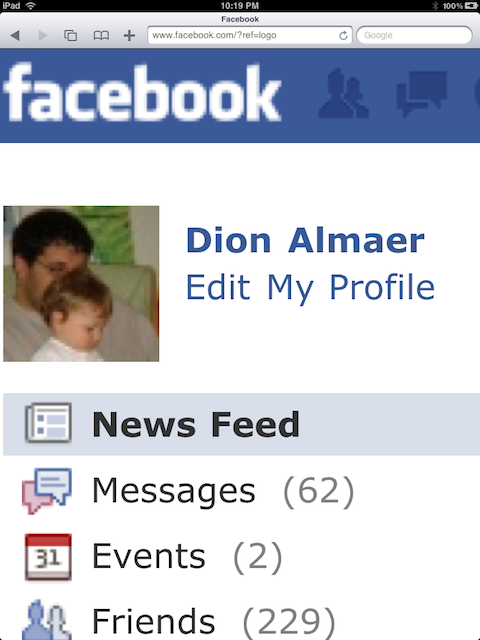
Facebook page as a vector example

When you look at the image above, the rasterized graphics look like crap, and the type looks great. We now live in a world where pinch and zoom is changing how your Web application is viewed. In the past we had to deal with different screen sizes, and browsers started to get smarter with their “zoom” going beyond “font size++”, but it isn’t like todays feeling that your users are pinching you, and you don’t know how hard.

The folk behind SVG all cheer. Those who enjoy Raphael as it gives you a nice API to that world, have also shown you this goodness for awhile. In Inkscape we have even have a decent tool:

An Open Source vector graphics editor, with capabilities similar to Illustrator, CorelDraw, or Xara X, using the W3C standard Scalable Vector Graphics (SVG) file format.

Inkscape supports many advanced SVG features (markers, clones, alpha blending, etc.) and great care is taken in designing a streamlined interface. It is very easy to edit nodes, perform complex path operations, trace bitmaps and much more. We also aim to maintain a thriving user and developer community by using open, community-oriented development.

There is even a new tool. Leonardo is a new vector drawing tool by Josh (note: who works in Developer Relations with me at H/Palm):

Leonardo is an open source vector drawing program for the 21st century. It focuses on common tasks like mockups, sketches, and presentations with a clean and consistent user interface. It is designed to be augmented by internet webservices and plugins created in several scripting languages.

  • vector drawing with bezier curves and geometric primitives
  • reusable symbols stored in a sidebar
  • integrated creative commons Flickr search
  • building simple multi-page presentations
  • export to PNG, HTML, SVG, Email, and Twitter.

Do you think about vectors more these days?

Aug 05

Google Wave’s Goodbye

Google, Tech 2 Comments »

sydneywave

I remember talking to a friend who joined Google and the Wave (then Walkabout) teams in Sydney. He talked about how he was excited to push the Web in crazy new ways and that he was shocked at how far they had gone. He also said “but I have no idea if people will use this.”

Google-haters will make fun of the fact that Wave hasn’t been a commercial success. “See! They are a 2 hit wonder! Search and Ads!” However, I think that Eric’s spin rings partly true. Google had the balls to do it. They let Lars and an awesome set of engineers take a run and rethinking the way that we communicate.

This is an incredibly hard proposition. Many people live in their email (I know, I know, the kids live in FB mail right?). I find myself loving a Gmail plugin whilst never getting into Wave. Incremental, evolutionary improvement often wins on the Web. The revolutions are hard, but that doesn’t mean that people should stop trying them… and Google has the $ and the need to scale their businesses.

Wave, as well as giving great demo, has brought a lot of cool technology into the commons. Other projects like Novell Pulse and the like are using it. When I was working on Bespin I really wanted to see a world in which Bespin could run on top of the operational transform abilities of Wave. Good things will come of Wave. The engineers have learned a ton, and that will go throughout the company to their other products. Making Gmail incrementally better will be huge. There is the large Google Buzz team making a run for social (a touch play when competitors have massive mindshare and user bases).

I also wonder about Etherpad. That great team shipped off to Sydney to join Wave. I love Etherpad. I still use it at typewith.me and at other clones when that goes down. The vision of Etherpad was smaller than Wave, but incredibly useful. I hope those guys land well. The entire Wave team is top drawer. They were ahead of the game this time around …. and timing is everything.

Aug 02

Rapportive: A fantastic social email service with fantastic service!

Tech with tags: , , 2 Comments »

rapportive

I can’t tell you how much I love Rapportive, the service that makes Gmail better by taking away the ads, and adding in useful information about the sender (teh social).

I have played with “social email” type plugins before, but they always tried to do too much, and rarely anything useful. Email is important to people. You tend to live in it. So, if you have an “add-on” the best thing to do is to quietly whisper useful information into the email users ear as they go about their business.

Once you install Rapportive, your email life instantly changes for the better. When I get an email from someone new I suddenly get a face to the name (via the profile picture), a feel for who they are (from their social updates), and more.

There are other fun side effects. I have had a few spammers de-cloaked for example. In general I feel like I have a leg up in a new conversation. Email feels different to me. I would hate to have it taken away…. which is a great sign.

The team behind Rapportive is equally awesome. They came from the great hacker dojo of Y Combinator, and other investors have come in behind that…. including Mr. Gmail himself.

The reason that I am actually writing this email though, is their service on behalf of their service.

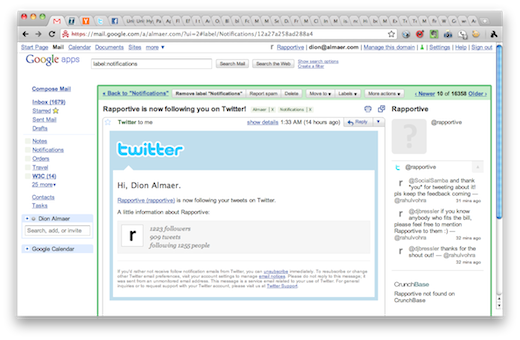
There are a series of emails that I get that come from the same email. A lot of them fall into my “notifications” tag: Follows from Twitter, messages from Facebook, comments from Wordpress, plans from Plancast, etc.

rapportivetwitterfollow

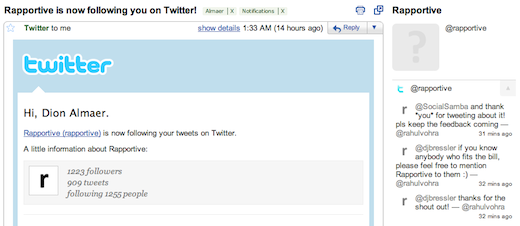
Until recently, Rapportive hadn’t really done much for me there. Then, the team started to show information from the website of some of the companies behind these messages. I then reached out and said, what I really wanted was more meat that could be gleaned from the email. My use case was Twitter. When someone follows me, the more info I have on them, the more likely I am to follow them back. Twitter improved their template email a few weeks back (although for some reason it seems to have reverted for me recently?) but they don’t put in recent tweets from the person. I can see why: spammers would LOOOOOVE that feature. However, I would love to see it as I decide if I should reciprocate the follow! Rapportive could dip into the email content, parse out the fact that @foo has followed me, and show me their Tweets.

I don’t even think it was a full 24 hours later, and @rahulvohra their CEO, let me know that the feature was in place. I tested it…. and it was.

How about that for service.

ps. I love that Rapportive is an extensible platform. You can write “Rapplets” which are plugins for that right bar. E.g. load in Crunchbase information. I do find that some of these bug me when they say “Bob not found on …” when I would rather just not see anything.

I have a bunch of ideas for Rapplets, and after the great response from the team, I have every incentive to writeup thoughts on how to make the service better too. If you use Gmail, you should get this plugin.

pps. It is great timing for someone to build this service. We have had good ole microformats for awhile, and now with Web Finger integration here and there, let alone various services that key off of email, it is coming together that you can actually get a lot of good info based on just an email address.

Jul 29

Capability based JavaScript loading; JS libraries catch up to GWT

Ajax, JavaScript, Tech with tags: 6 Comments »

ballandchain

Web developers have to walk around dragging a ball and chain. It is fantastic that we have a ridiculous install base (browsers, the Web runtimes) and a dynamic language in JavaScript.

The ball and chain though is the fact that we have to care so much about the payload of the application that we write. Less code means less bytes to download, and less for the JS runtime to load up.

This has bad consequences:

  • You are tempted to write hard to understand code
  • You have to balance functionality and code size much more than other environments
  • You end up getting tricky and come up with ways to dynamically load modules on demand
  • All of this time is time not spent on the app logic.

When you run into a problem like this in computer science what do you do? Build an abstraction!

GWT has done a great job here. It’s very nature requires a compilation step, and once you have to deal with that step…. you can do a lot at build time to change the above dynamics.

For example:

  • You can write nice explicit source code, and trust that the compiler will output optimized JS (which can look as ugly as sin for all anyone cares)
  • Your application can get faster with a new release of GWT, as the compiler gets better
  • A lot of advanced techniques such as code splitting, and deferred binding can be applied to allow logic to apply at build time as well as runtime.

Ignoring GWT, when you write a pure JS application for the Web, you are writing a cross platform application. Unlike clean portable C, you don’t have that compilation step to do clean up work for you on each platform, so you end up with a lot of runtime conditional logic.

You try to do object detection rather than user agent conditional, but still, you end up both downloading the code necessary to run in all environments, and you have the overhead of loading and executing that code.

Chances are you are smart and don’t do if() checks all the time, but maybe do so once when loading up. For large chunks of big differences, maybe you do something like:

var Foo = (sometest) ? function() {
    // do it like this
} : function() {
    // do it like that
};

If you take a look at some parts of popular JavaScript frameworks, you see that they are abstractions or fixes for various browsers. As browsers have stepped up to the plate recently, they have fixed a lot, and suddenly you take a step back. A lot of frameworks have a chunk of code to give us the ability to do smart things with CSS querying. Modern browsers support querySelectorAll (even with some bugs) and getElementsByClassName so a lot of the code is un-needed…. unless you care about the old browsers.

We shouldn’t have to download all of that cruft on the other side of the if() statement when we don’t use it!

The GWT compiler can output versions of your application targeted to a given browser. Only the fastest, minimal code, will get sent down. Deferred binding goes far beyond just browser type (can deal w/ locales and much more) too.

GWT isn’t the only horse in this race though.

Alex Russell started to sprinkle in some directives to Dojo that would enable you to do a build that is WebKit targeted. A major use case for all of this is making sure that you are sending down lean code in the mobile space. It can matter everywhere, but when you are dealing with grown up walkie talkies…. you want to really optimize.

And this brings us to YUI. I was really excited to see some of the features in the YUI 3.2.0 preview release. Great stuff for touch/gesture support, but what stood out for me was “YUI’s intrinsic Loader now supports capability-based loading”. A-ha!

I poked around the source to see how it was used. Here is one fake example that shows how it works. When you boot up YUI you can add in “conditions” which are in charge of working out whether to load something. You can currently tie on to user agent, or write a test function:

YUI({
    modules: {
        lib2: {
            requires: ['yui'],
            fullpath: 'js/lib2.js',
            condition: {
                trigger: 'node-base',
                ua: 'gecko'
            }
        },
 
        lib3: {
            requires: ['yui'],
            fullpath: 'js/lib3.js',
            condition: {
                trigger: 'event-base',
                test: function(Y, req) {
                    return Y.UA.gecko;
                }
            }
        }
    }
 
}).use('node', function (Y) { .... });

The YUI team uses this themselves to only load certain ugly DOM stuff for IE6 when needed:

"dom-style-ie": {
    "condition": {
        "trigger": "dom-style", 
        "ua": "ie"
    }, 
    "requires": [
        "dom-style"
    ]
},
 
YUI.add('dom-style-ie', function(Y) {
    // ....
});

This makes a ton of sense, especially for the libraries themselves to do this work. They are the ones that do the heavy lifting of cross browser ugliness, all to allow us to write to an API that works.

Beyond that, we can then ourselves split out code if it becomes a performance issue.

Of course, the value of the test() function is that you can do capability based testing (not just user agent testing…. hence the name!). This means that you can do a test say for Canvas support (as Zach mentions in the comments) document.createElement(’canvas’).getContext, and load up excanvas or another shim library if it doesn’t exist.

Using modernizr and ilk, we could build out “plugins” for YUI that auto load based on common capabilities. You can imagine running a YUI build, having it detect that you are using a capability, and then automatically load up a plugin that has the condition all loaded up. What a great user experience as a developer!

Maybe it makes sense to come up with a common pattern and conventions for dealing with this issue. How do you name your CSS/JS? Do we setup server side hooks so we don’t even need loaders necessarily?

I can certainly see a day where you may be asking the Google Ajax Library service for jquery.js, but it is returning jquery.ie.js to you.


Jul 14

I = V / R; Ohm’s law explains Developer Advocacy

Tech with tags: , , 3 Comments »

thestream

I consider myself a developer who happens to love community, evangelism, and advocacy.

When I put on the developer relations hat, I am constantly asking myself what value these roles have, and how to add more value to the process.

When I was working at Google, a certain engineering manager made it very clear that he felt advocacy and evangelism added close to zero value. His position was that you if you build a great product, developers will come. Rather than lash out, I keep that in the back of my mind, and think about how to make that view incorrect.

I keep coming back to Ohm’s law which explains the relationship between current, potential difference, and resistance and the laws of electricity.

I still remember the crazy physics teacher that I had that would scream:

“It’s the volts that jolt but the amps will kill ya!”

He would then kindly put kids through an experiment to get close to showing the truth behind that statement.

If you think of this law as a pipe and water flowing through it, there is the radius of said pipe, how fast the water is being pushed through it, and the resistance of the pipe.

How does this relate to developers and developer advocacy?

To reference the afore mentioned engineering manager, he has some truth. I feel like developer evangelism can help with the “push” (the volts). However, if you take the best developer relations crew… a crew that can push hard… they won’t be able to reach any potential if the pipe is tiny small, and the friction of the tools, APIs, platform, or economics provide.

Thus, the most important thing that you can do for a developer oriented initiative is first create a fantastic pipe. The pipe should have as little friction as possible, and should be as large as possible. Probably the most important way to achieve those goals is to provide developers with:

  • A fantastic economic opportunity. Let’s face it, if Apple restricted developers so they had to use punch cards to build iOS apps, we would still have a lot of apps :) Same goes for Facebook etc. Even though when you look at the numbers on even those platforms, success is a “hit based” economy, the hits do so well that many developers get in the water for their change
  • A chance to do something different. Create a platform with unique capabilities and the opportunity for developers to create something very different, and that itself will be a draw. New companies and products can be created where they didn’t exist. Nokia had (and has) a boatload of phones. At JavaOne for years a Sun exec would get up and say “developer a J2ME app and you can reach BILLLLLLLIONS of devices!” Few did in the scale that we see with so called “smartphones”. You just couldn’t create anything interesting or compelling (oh, and there are the carrier gateway issues of that time too)
  • Make your platform fun and generative. This is a sub-bullet of the last one in many ways. But, if you a developer can have a great time creating on top of your building blocks, great things will happen, and the network effect can flow.

Now, evangelism comes in as a way to:

  • Let developers KNOW about your fantastic economic opportunity, their chance to do something different, and how productive and fun it is to develop on.
  • With tools, samples, articles, conferences, and community in general…. help lower the friction for these things. Give developers a leg up.

This push can have a huge effect. Good evangelism will also create external evangelists who share your excitement and vision ending up with a nice network effect.

Only half the story

But evangelism is only a piece of the story. The reason that I like the term “developer advocate” so much (and why I posted on this topic) is because it shows the other side of the coin. You are the third party developers representative back at your platform company. You are letting the internal teams understand their needs. And, you get to be part of that community:

“I can advocate something, and part of that will hopefully be heavily listening, and participating in the open community. Of course, these are just words, and you have to make this happen. We could call ourselves evangelists and do a lot of listening, or become advocates and do none. The word choice though does make you think about what you should be doing.
More importantly, in my opinion, is the word developer. Rather than talking just about technology, we are talking about humans who use it. This again makes you feel like you need to be more part of the community, working with developers on their level.”

Every now and then I reflect on Ohm’s law (it helps to watch the current of a stream in the mountains as I have been able to do in Colorado this week!), and think about how me and my team can both relieve friction and push harder for developers on the platform.

I have been at HP for a week or so now, and thus it was a great opportunity to think about how we can come together as a team to do just this. I think that I will be personally changing what I do, and I can’t wait to work with the community, the internal engineers, and the product chaps as we take webOS to the next level.

Jul 12

Diffable; What if GitHub supported it natively?

JavaScript, Open Source, Tech with tags: 3 Comments »

Steve Souders told me about Diffable, when I saw him after his awesome Velocity conference.

Diffable is an open source project that allows you to only send down the deltas in your application versions, versus full new downloads (which may have a large amount of duplicate data).

In their presentation, Josh Harrison and James deBoer, talk about the details after the start with the core issues:

Problem:

Frequently modified web resources must be downloaded in their entirety with every modification.
Even a small change invalidates the cache.
Rich internet applications often have large amounts of static content.

Idea:

Initial application resources kept in cache.
Changes to cached versions transmitted as deltas.
Deltas merged client-side to generate latest JS version.

Benefits:

Faster page load times for users with cached resources.
Small changes to large resources incur only small costs.

Steve summarizes things well in his post:

Diffable uses differential compression to reduce the size of JavaScript downloads. It makes a lot of sense. Suppose your web site has a large external script. When a new release comes out, it’s often the case that a bulk of that large script is unchanged. And yet, users have to download the entire new script even if the old script is still cached.

Josh and James work on Google Maps which has a main script that is ~300K. A typical revision for this 300K script produces patches that are less than 20K. It’s wasteful to download that other 280K if the user has the old revision in their cache. That’s the inspiration for Diffable.

Diffable is implemented on the server and the client. The server component records revision deltas so it can return a patch to bring older versions up to date. The client component (written in JavaScript) detects if an older version is cached and if necessary requests the patch to the current version. The client component knows how to merge the patch with the cached version and evals the result.

With this technique in action, you end up sending down JS arrays as deltas that looks like:

[0,10,"red",40,3," leaps",25,15,16,3,"."]

The data that these guys share is impressive. The results seem to add up for applications as large as Google Maps. Do they measure up for smaller apps? If large apps have a lot of static content, couldn’t that content be put into another download and even app cached away?

Also, it is a lot of work to implement this for a developer. Work on both client side and server side. It would be great if we can experiment with Diffable and then move things lower into the stack. Why can’t HTTP itself be smart enough to deal with diffs?

It did make me think of my favourite chaps @github. I know that GitHub is about development rather than deployment…. but what if they supported this natively (since they kinda grok diffin’ etc already) and offered a client side loader so you could github.load("project", ...).

It all just makes me realise that GitHub is poised to pounce in many directions. Good on ‘em.

Jun 02

Will we feel like stick shift drivers? The potential shift in the OS marketplace

Apple, Comic, Tech, Web Browsing, webOS 1 Comment »

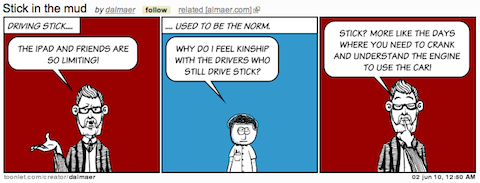
stickinthemud

I have been talking in analogy for the last few days. The common meme is relating the computing usage trends to that of the car industry. As I watch continue to watch my family use their devices, it does feel like things are changing. My mum continues to thrive on her iPad / Palm Pixi combo. She feels empowered to try the different corners of the experience. To download new experiences. She is having fun.

stickshift

One friend suggested that it is like the shift (pun intended) that we saw when automatic transmissions were introduced. At first they were expensive and had some issues, but being able to have simple controls changed the way that people drove. It became so simple. There were people who cried that it would never take off. “People want the control of a manual stick shift system!” However, although we continue to see some die-hards, the vaste majority of the US population drive automatics (this isn’t true everywhere in the world). That battle is over. We will never go back.

The iPad experience is like driving the computing experience without the manual hassle. You don’t have to know how to install the engine to start out (install an OS), nor deal with (and worry endlessly about) the workings. In general, you just don’t need to worry about all of the abstractions any more. The notion of files. And, don’t get me started on viruses.

As my mother thrives on her iPad, I use it sparingly, mainly as an entertainment consumption device. Wait a minute: Am I am the guy who loves the stick shift and never wants to jump to an automatic? I am a little different from the religious chaps who claimed they couldn’t understand why anyone would want an automatic. Or looked down on those people. I understand why my Mum prefers the iPad experience.

I do find the iPad experience often frustrating however. My “why did the car shift then? it wasn’t time!” moments occur mainly around the restricted access to customization, and the inherent and enforced immersion.

First a small thing, which will unfortunately show off an how anal I can be:

bbcname

I want to rename this to “BBC News”. I am the guy who winces when someone bookmarks a page and doesn’t rename it, thus having “Foo.com – a barish company that deals in widgets, gadgets, monkeys, and flubbers”. I want to jump in and rename it to “Foo” on the bookmark bar. More space. More room. Petty for sure.

Where it gets more real for me is in the lack of integration between applications. Being immersed with one application at a time can be a fantastic thing, I will give you that… even if I often would love to give a bit of screen real estate to me Twitter stream while working on another app right next to it. However, if you live in an immersive environment, you need great integration between experiences. I should be able to Tweet/Share from any application, and not have to close down the app, go to a Twitter client, and get back to the app that had content I was tweeting. A lot of this comes down to multitasking, but more comes from integration….. and putting intents on a stack. On the iPad I feel like I am jumping through doors without an easy way to go back.

The browser has some of these notions baked in. States have URLs that I can bookmark. I can go forward and back. I can search. I can fork off (new tab). Turns out, I really like those abstractions, and miss them when they are not there, and every single app tries to reproduce some of them. They are often cross cutting concerns. I don’t want the app developer to have to write code and choose where to put a “Share” button. I want the system to know that I have an account on Twitter and let me share with a simple gesture.

Back to the Web. I was a little stunned when a friend showed me the Speed Test.net experience on an iPad:

speedtest

Yup, if you go to speedtest.net, you are automatically redirected to the App Store. There is no way to trick it (again: would be nice to have customizability and tweak user agents etc).

To the credit of the speed test developers, the website is driven by Flash, which won’t work…. so they are trying to do something good for a user. I get that.

However, I am scared to death to think of the Web going this way. You go to websites and get sent to apps directly. I *do* want user agents to tell me if apps are available (hence the App Discover experiment), but don’t force me into the world of apps. I also think that doing what YouTube does and take over a URL in a certain way can be a good thing. I would love to install handlers for mime types…. so a certain link always opens up my favourite Twitter client say.

I personally prefer many of the Web experiences to the “new” app experiences. (I talked earlier about the abstractions that I find useful). This could break the Web. Data that was shared at the ReadWriteWeb Mobile Summit showed that the same users often hit a site using: mobile website, full website, and application. We are context switching in real-time already. Different views are best for different use cases.

It definitely feels like there is a shift in the force. We need to get the balance spot on as we move to automatic transmissions. What should be customizable. What should be locked down. As developers as well as consumers, we need to make our voices heard. What do you think?