Jun 22

Endpoint Resolver: Getting tinyurl out of the Twitter stream

JavaScript, Tech, Web Services with tags: , , 11 Comments »

Sometimes you can get in the zone just enough to be productive on a plane. On my flight to Mexico City yesterday, I created Endpoint a project that contains a server proxy, JavaScript client, and Greasemonkey Script with a mission. The mission is to take a URL, work out if it is a redirect (via a Location: header), and then return the final endpoint for it.

Why did I do this?

I was brainstorming functionality for a Twitter client with James Strachan (he is working on gtwit) and we talked about how annoying tinyurl / is.gd / snurl / you name it URLs are. They don’t tell you where you are going, and you could get Rick Rolled (if you are lucky) or much much worse.

So, I wanted to create a library, and one client (Greasemonkey) to test it out. Then anyone else could use it too to resolve directly from their Web pages.

How does it work

You load up the JavaScript via script src and then you can call resolve, passing the URL and a callback that will get the result. A few examples:

// Simple version
Endpoint.resolve('http://snurl.com/2luj3', function(url) { 
  alert(url); 
});
 
// Using the original URL to work out if it has changed
Endpoint.resolve(
  document.getElementById('testurl').value, 
  function(url, orig) { 
    alert(url); 
    alert(Endpoint.isRedirecting(url, orig));
  }
);
 
// How it is used in the Twitter Endpoint Resolver
Endpoint.resolve(url, function(resulturl, originalurl) {
  if (!Endpoint.isRedirecting(resulturl, originalurl)) return;
 
  newtext = newtext.replace(originalurl, resulturl, "g");
  jQuery(el).html(newtext);
});

Under the hood, a bunch of stuff is happening. I would love to be able to just use XMLHttpRequest to dynamically hit the URL and look at the headers, but the same-origin policy stops me.

This is why I have the server proxy, which returns a JSONP callback.

When you call resolve(url, callback) the script tag is created on the fly and added to the DOM. The callback function is all handled to allow multiple calls, and then the chain unravels.

Here you can see it all in action, showing how my Twitter stream will go through and the URLs will dynamically change from their tinyurl versions to whereyouaregoing.com:

I wanted to use App Engine to host the server proxy, but unfortunately I can’t work out how to do that yet. You have access to the URLFetch API to access resources from App Engine. Unfortunately for me, one of the features is that it understands redirects and just goes on through to the full resource itself, with no way to get the endpoint from the headers in the response.

It was also interesting to read Steve Gilmor talk about these services all be it in a post that is hard to actually understand ;)

Also, Simon Willison just put up a simple service on App Engine, json-time, that “exposes Python’s pytz timezone library over JSON.” I think that we will see a lot of these types of mini-Web services hosted on App Engine. Taking Python utility and making services from its goodness is an obvious choice.

Jun 17

Addressbook History goes into the cloud with App Engine

Ajax, JavaScript, Python, Tech with tags: 1 Comment »

I recently built an example of the Form History Pattern using an Addressbook case study.

I found myself talking about App Engine on the On Air tour, so I decided to change the example to not store the data locally with Gears, but instead to save it away into the cloud via App Engine.

RIBs

Why did people want to hear about App Engine at an Adobe conference? I think that Jonathan Schwartz got it when he mentioned rich internet back-ends. As you build rich clients, you suddenly realise that the promised benefits of web services can kick into gear nicely.

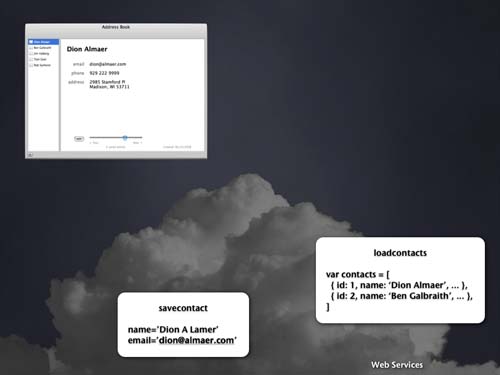
Addressbook Services

Back to the sample. The architecture change was quite simple. Where I was doing a local DB save, I would call a back-end service such as /loadcontacts or /savecontact depending on the task.

You can view and download the full App Engine project code for this sample, and you can see it running live on App Engine

Check out the video below, or view the high quality version (recommended) to see the code walk through, and the various tools that App Engine gives you to develop, debug, and monitor your application running at a few thousand feet.

Apr 28

Twitter Translate: Automatically convert tweets to your language

JavaScript, Tech with tags: , , , , 13 Comments »

Twitter Translate

I am having a lot of fun with the AJAX Language API. Last week I talked about the translation bookmarklet that lets you translate anything that you select in the browser.

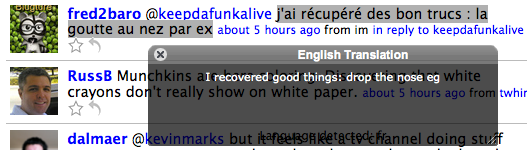
This time, I whipped up Twitter Translate, which watches the tweets in the page, and if the content isn’t your native tongue automatically converts it and replaces it inline. It then adds a mini logo with “translated from …” which you can click on to see the original text:

Twitter Translate Example

It is probably easiest to quickly see it in action:

I think that I am so excited about this API as it is a vertical service that you can just use for free. Think back on how you would be able to integrate language into your applications in the past. You would either:

  • Have to work on the discipline yourself, which is crazy if it isn’t your core business
  • Find a vendor that has some product that you can use, all of which are very expensive.

Now, we can use this service for free, and the best part? It will keep getting better behind the scenes without us having to do a thing!

Apr 27

Ext JS: A reminder that you are not alone

JavaScript, Open Source, Tech 1 Comment »

Alone

Every now and then, normally when talking to a libertarian, I think about how we are actually all connected to each other. It is impossible to sandbox yourself from society which leads me to conclude that I need to embrace it and do what I can to work out what kind of society we want to be.

With the current Ext JS debacle, you get reminded of how connected your project and business are to other people. Just because you own a company, doesn’t mean that you control it. When I think about my own company, Google, I realize that the most important currency is user trust. It doesn’t matter how many PhDs and great technology releases we have, if we ever lost some of the trust. I think that Google has earned its reputation, but all it would take is something that goes against what we have stood for so far, and we could lose it just as fast. I actually like this fact, as it keeps us honest.

It is a little like your tennis ranking. A rolling year of past performance is what really matters here. It doesn’t matter if you won that grand slam one year and one month ago. This is why every tournament matters. A bad showing loses points.

Of course, with user trust it is a lot more nuanced, and the graph is more exponential (the longer you go back in time, the less it matters).

Anyway, enough side tracking. When you have a software project that is a library for developers, your end users are those developers. If the project is open source, then there is a clear communication of the rules through your license. This is why open source licensing is so important. It allows you to have a simple contract saying “this is what you can and can’t do”. As a developer I can see GPL, BSD, Apache, and I know right away what kind of community this is, and how I can play a role. It isn’t about one license being better or worse than another. It is about communicating rights.

If you are fortunate enough to gain a real community, where other developers are participating, then the game starts to change. Now you have people who are invested in your project, maybe building on it for you, or evangelizing it, writing documentation, or creating their own business. At this point you really start to see what kind of project it is going to be, above and beyond the source code licensing. This is the Open Community side of a project. It can range from: only people who work for company X contribute in anyway, to: active commiters from all over the Web. This paints a picture of the project as a whole, and will have large effects on project, including who uses it. This is all about governance.

This also comes into play in other ways. When you think of Apache, or the Dojo foundation, you know about the legal protection that comes through the process. You know that everyone has signed a CLA, and that the history of the code is clean and well known. This has a huge effect on getting large companies into the game (This is why companies like IBM and Sun are so involved in Dojo IMO).

Now that you have users of various stripes, and a community with varied roles, you also have connections through out. If you then change the open source license for your project, the contract in the community has changed. When you make a change you not only need a good reason, but it has to be transparent, and you obviously have to get all of your ducks in a row to even be able to pull it off (e.g. depending on the change you may need every author of a line of code to get involved).

With Ext JS, there was a strange situation. The original license of LGPL-ish was very confusing, which lead to a confused community. Some kind o change was required, and clarity needed to be brought in. Unfortunately, it seems that the move to GPL has caused more chaos and confusion. Developers who poured a lot of time into the community (e.g. by creating GWT-Ext) are upset. The chaos can rip the community apart and you end up with a true lose-lose. Jack has spent far too much time and grey hairs on this one, instead of writing great code and growing his business.

So, it acts as a reminder, that the community is all connected. Everyone may not be equal, but make sure that communication is incredibly clear at all times to make sure that something like this doesn’t happen.

Apr 25

Translate: Select any text in the browser and have it convert to English (or your language)

Ajax, Google, JavaScript, Tech with tags: , , 7 Comments »

Translate Bookmarklet

I really liked getting the Ajax Language API out into developers hands as god knows we shouldn’t have to worry about translations. Now we can use the API and have the Google back-end do all of the work.

I have recently had a couple of scenarios where I really wanted a quick translation. I had a few twitter messages pass through my stream in French and Spanish. I had the answer to some technical issues show up on foreign forums.

So, I decided to create a Translate bookmarklet that allows me to select any foreign text, click on the bookmark, and a little window pops up with the English translation if it can work it out. Automatic translation is far from perfect yet, but for many scenarios you can easily get the gist (e.g. you wouldn’t want to automatically convert a book).

This is how I created the bookmarklet:

The source

First, I have the raw JavaScript source that will become the bookmarklet. There are a few sections of the code. First, we setup a method that will go off and call the Ajax Language API, passing in the translation and language that we want. This is where you would change the language code for non-English.

if (!window['apiLoaded']) {
  window.apiLoaded = function() {
    var language = "en";
    var text = window.getSelection().toString();
    if (text) {
      google.load("language", "1", { "callback" : function() {
        google.language.detect(text, function(dresult) {
          if (!dresult.error && dresult.language) {
            google.language.translate(text, dresult.language, language, function(tresult) {
              if (tresult.translation) {
                translationWindow(tresult, dresult);
              } else {
                alert('No translation found for "' + text + '" guessing the language: ' + dresult.language);
              }
            });
          }
        });
      }});
    }
  };
}

Then we setup a method that is able to display a window showing the result. I used the Prototype UI Window object if available, and good old alert() if not:

if (!window['translationWindow']) {
  window.translationWindow = function(tresult, dresult) {
    if (window['UI']) {
      new UI.Window({theme:  "black_hud",
                   shadow: true, 
                   width:  350,
                   height: 100}).setContent("<div style='padding:6px'>" + tresult.translation + "</div>")
                   .setHeader("English Translation")
                   .setFooter("Language detected: " + dresult.language)
                   .center({top: 20}).show();
    } else {
      alert(tresult.translation + " [lang = " + dresult.language + "]");
    }
  }
}

Next, we load the Prototype UI window code, and accompanying CSS resources by dynamically adding the resources to the DOM:

if (!window['UI']) {
  var pw = document.createElement('script');
  pw.src = 'http://almaer.com/downloads/protowindow/protowin.js';
  pw.type = "text/javascript";
  document.getElementsByTagName('body')[0].appendChild(pw);
 
  var pwdefault = document.createElement('link');
  pwdefault.setAttribute('rel', 'stylesheet');
  pwdefault.setAttribute('type', 'text/css');
  pwdefault.setAttribute('href', 'http://almaer.com/downloads/protowindow/themes/window.css');
  document.getElementsByTagName('body')[0].appendChild(pwdefault);
 
  var pwblack = document.createElement('link');
  pwblack.setAttribute('rel', 'stylesheet');
  pwblack.setAttribute('type', 'text/css');
  pwblack.setAttribute('href', 'http://almaer.com/downloads/protowindow/themes/black_hud.css');
  document.getElementsByTagName('body')[0].appendChild(pwblack);
}

Finally, we load the Google API loader, and use the dynamic loading option with the ?callback=apiLoaded. This kicks off the main driver that we saw first, and if it is already loaded we call it directly (for multiple translations on the same page).

if (!window['google']) {
  var s = document.createElement('script');
  s.src = 'http://www.google.com/jsapi?callback=apiLoaded';
  s.type = "text/javascript";
  document.getElementsByTagName('body')[0].appendChild(s);
} else {
  apiLoaded();
};

“Compilation”

This is the raw form, and we need to get the bookmarklet form, which you can just use right away if you are wanting English. For this, I use John Grubber’s makebookmarklet Perl script to do the conversion.

The Server

The Prototype UI code lives on the server, so I put a striped down version over there which just contains a combined Prototype + Window JavaScript file, and just the one theme CSS set.

In Action

Unsure what I am talking about? Just watch it in action:

UPDATE: I also implemented Twitter Translate to automatically convert tweets to your language.

Mar 24

Upgrade the Web: Do you want your browser to Jabber away?

JavaScript, Tech, Web Browsing with tags: , 2 Comments »

Old Men Talking

Aaron Boodman was probably right in thinking that me wanting OpenID in the browser makes more sense as a browser feature, or separate plugin. This is a consumer level feature more than a developer focused one.

As I ruminate in the world of wishful thinking, I started to wonder about Jabber, and how it would be interesting to have XMPP as a native browser protocol.

We do have Jabber plugins, and there are JavaScript libraries that implement Jabber, but shouldn’t this be in the browser?

Jabber seems to be popping up all over the place. It started off as the IM protocol, and now has become a generic, scalable, messaging system. If XMPP was native and reliably in browsers, imagine how it could help the chat in Gmail? It could also transform the chat relationship with the Web. Social browsing as Me.dium does it could become more integrated. For example, I could have a trivial way to enable group chat on Ajaxian. I would love to be on the site and have others who are on there tell me how things are going, give me tips, and have comments feed into the same system. I shouldn’t have said “enable” as I wouldn’t have anything to do with it.

At an API level, we could also access XMPP from JavaScript.

Hmm, actually, is there a way in which this could tie into single sign-on and OpenID? Could XMPP be the way to login?

Mar 03

xssinterface and Google Gears

Gears, JavaScript, Tech with tags: 1 Comment »

I mentioned the cross domain library, xssinterface, created by Malte Ubl on Ajaxian the other day.

His library abstracts on top of postMessage() and browser hacks to give you cross domain work. No sooner than I say “It would be nice if the library used cross domain workers if Gears is installed.” than Melde comments “Thanks for the hint to google gears. It is now implemented in trunk :)”. How about that for service!

Below is his first version that uses cross domain workerpools and the database to keep a message queue going. Very nice!

var wp       = google.gears.workerPool;
wp.allowCrossOrigin();
wp.onmessage = function(a, b, message) {  
  var origin = new String(message.origin);
  var parts  = origin.split("/");
  var domain = parts[2];
  parts      = domain.split(":"); // remove port
  domain     = parts[0];
 
  var recipient = domain;
  var channelId = message.text;
 
 
  var db = google.gears.factory.create('beta.database');
  db.open('database-xssinterface');
  db.execute('create table if not exists XSSMessageQueue' +
     ' (id INTEGER PRIMARY KEY AUTOINCREMENT, recipient_domain TEXT, channel_id TEXT, message TEXT, insert_time INTEGER)');
 
  // delete (and thus ignore) old messages
  var maxAge = new Date().getTime() - 2000;
  db.execute('delete from XSSMessageQueue where insert_time < ?',[maxAge]);
 
  // find new messages for me
  var rs = db.execute('select id, message from XSSMessageQueue where recipient_domain = ? and channel_id = ?', [recipient, channelId]);
 
  // there is a new message for the recipient
  if (rs.isValidRow()) {
          var id   = rs.field(0);
          var text = rs.field(1);
          db.execute("DELETE from XSSMessageQueue where id=?", [id]); // unqueue message
          wp.sendMessage(text, message.sender)
  }
 
  rs.close();
}
Feb 21

Google Gears API supported by Aptana Jaxer

Gears, Google, JavaScript, Tech with tags: , No Comments »

Man I love it when I can delete code. Seeing the line count go away and leaving a small amount of text is a sight for sore eyes. I got to delete a lot of code today thanks to the kind folks at Aptana.

I recently wrote a shim that allows the Google Gears API to run as is on the server side. It wraps the Gears Database API with the Jaxer one.

What is particularly cool about this is that you can then write some code and:

  • If the user has Gears installed, it runs client-side
  • If the user doesn’t have Gears installed just run it on the server

I want to setup a nice way to make this trivial to setup.

The majority of the code was a simple wrapper around the result set, so Aptana decided to directly support the Gears API itself which allowed me to get rid of it all!

This makes the shim as simple as this:

// -- Wrap this code so it is available if using a proxy call
function oncallback() {
 
  // Make up the namespaces to mimic Gears and a place for Jaxer holders
  google = {}; google.gears = {}; google.gears.factory = {}; google.gears.jaxer = {};
 
  // Create sets up a database instance to be used
  google.gears.factory.create = function(className, version) {
    if (className.indexOf('database') < 0) {
      throw new Error('I can only do Database work right now');
    }
    return new google.gears.jaxer.Db();
  }
 
// -- The Database Wrapper
  google.gears.jaxer.Db = function() {
    this.db = null;
  }
 
  google.gears.jaxer.Db.prototype.open = function(name) {
    this.db = new Jaxer.DB.SQLite.Connection({
      PATH: 'resource:///../data/' + name + '.sqlite',
      CLOSE_AFTER_EXECUTE: 'open'
    });
  }
 
  google.gears.jaxer.Db.prototype.execute = function(sqlStatement, argArray) {
    var rs = (argArray) ? this.db.execute(sqlStatement, argArray) : this.db.execute(sqlStatement);
    return rs;
  }
 
}

Philip Maker has also taken GearsORM and made it work with Jaxer. Very cool indeed.

Feb 17

Interview Day: JavaScript

Comic, JavaScript, Tech with tags: 1 Comment »

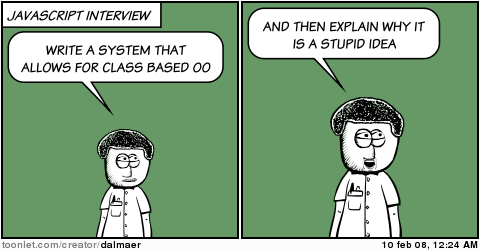
Interview: JavaScript

Write a system that allows for Class based OO… and then explain why it is a stupid idea

What about the other languages?

Got some good ones for other languages like Fortran, BASIC or assembly?

Feb 16

Microsoft Declares… Part Three

Comic, JavaScript, Microsoft, Tech 1 Comment »

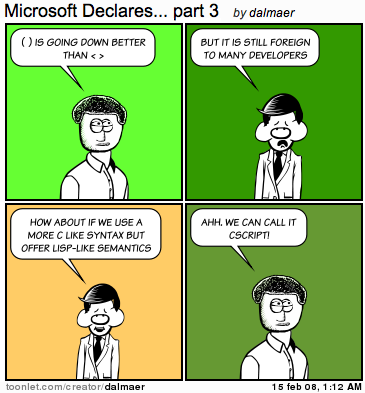
Microsoft Declares… Part Three

At first we had Nelly and XSL/T, and then we had Lisp. Now it is time to to evolve to C^HJavaScript.

ps. There is nothing geekier than a ^H joke.