I spent a lot of time advocating Gears. I loved the engineers (folks like Aaron Boodman who is doing great stuff with Chrome Extensions, and Chris Prince who now works on the fantastic Google Voice, and many many more…. many of whom are working on Chrome in some fashion).
Today the press is picking up the fact that Gears is dead, even though Google moved its efforts awhile ago (keeping life support turned on) and Linus talks about the focus on HTML5 and Chrome:
“We’re very focused on moving HTML 5 forward, and that’s where we’re putting all of our energy,” Upson said. “When we started the Gears project, three years ago, maybe three and a half years ago now, we did it because we couldn’t get the browser vendors interested in building offline applications. And so, so we said, okay, we’ll build a plugin that could do it. And lo and behold, once we shipped Gears, suddenly the browser vendors got very interested in adding capabilities to build offline applications.
“And so, I think Gears has accomplished its mission very well, in getting these capabilities into HTML 5,” Upson added. “In fact, the team that designed Gears was also instrumental in designing the HTML 5 versions of those APIs. You can almost think of what’s in HTML 5, with app cache, and database, and those things, as essentially Gears 2, and that’s how we view it.”
Many people are happy to wave good bye to Gears and look to the future of HTML5. I feel that too, but I do have a pang of “what coulda been”. The Gears team was incredibly pragmatic. How can we get Gmail Offline? What about other Google properties? This practical experience delivered Gears and the push for support of real APIs that developers need to deliver compelling experiences through the Web platform.
Although it is true that Google can push the cause through their own browser, their properties still need to deal with other browsers. ChromeFrame is one answer there, the new “Google Plugin”. The browser vendors are kicking into gear nicely now. Mozilla, Google, Apple, Opera, and even IE teams are working hard on new features and HTML5 support. When Gears started we (the Web developers) were in the dark ages of browser development. The IE team had moved on to WPF and Silverlight. The other browsers were fighting the fight against a huge IE6 dominant entry with lots of ActiveX keeping it in style.
Does this mean there isn’t a place for a Gears like solution? Yahoo! has BrowserPlus which has the additional benefit of allowing developers to write services. This was one of the issues with Gears. You got APIs that Google gave you. You had no way to extend the experience. Browser Plus allows that and I hope that Lloyd and team have a good 2010.
There is also JetPack (and Chrome Extensions) that allow you to extend the experience in a different way. If I had my way, Gears and Y!BP and JetPack would all have joined forces. That world would then look like:
- Gears/Y!BP allow functionality to work cross browser and offer a services framework to allow you to write new components that also work cross browser. This is fairly low level work, with some nice sugar for certain APIs.
- JetPack would give you access to low level APIs in a nice high level JavaScript API. Since it would run in Gears/Y!BP it would run cross browser too.
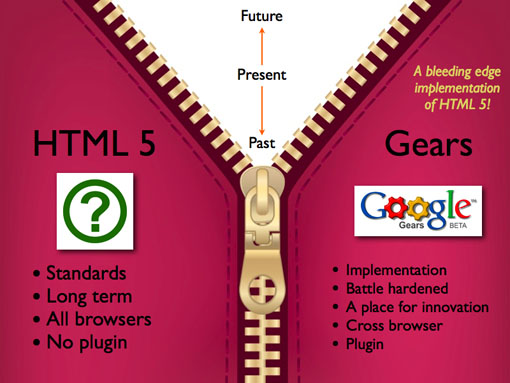
My wish for Santa? Have JetPack and Y!BP pickup and work together. Give developers a platform to create new services on the Web and have them work cross browser. We shouldn’t have to wait for browser vendors to implement APIs. We should be allowed to experiment more. Gears started its job with the zipper running higher, but there is always more room to run. If we worked out a way to get more people playing with the platform we could get so much more done. We saw what came out of “how could we do Gmail Offline” what about your application needs?
I will raise a glass to Gears and the new HTML5 overlord, but I will miss the vehicle for cross browser experimentation and what coulda been.